
Back to Homepage
Environment

Uzbek Muslims Pray For Rain Amid Severe Drought

Aglow News
December 1, 2025
Uzbek Muslims Pray For Rain Amid Severe Drought

Uzbek Muslims Pray For Rain Amid Severe Drought

Climate change is speeding up the melting of glaciers, a key water source for the approximately 80 million inhabitants of Central Asia.

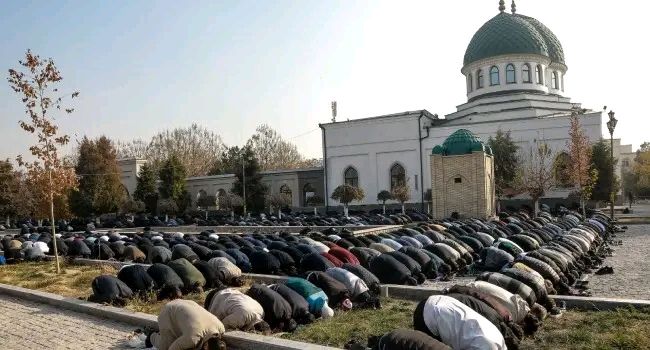
Uzbek Muslims held mass prayers for rain on Friday as the Central Asian country suffers severe droughts associated with climate change.

The prayers were held in 2,000 mosques across the Muslim country of 35 million people.

“We never had such prayers before,” 63-year-old faithful Abdurashid Rasulov told AFP at a prayer in the capital, Tashkent.

“But now, since the rain is delayed, our religious leaders instructed us to ask Allah for rain,” he added.

Anvar Abduazizov, 67, said, “We prayed for a blessing for our country and our land and for the rain to pour down abundantly.”

Uzbek Muslims perform a prayer for rain outside a mosque in Tashkent on November 28, 2025. Photo by TEMUR ISMAILOV / AFP

For Tashkent, the largest city in Central Asia, this year’s drought has been one of the harshest in 170 years, Uzbekistan’s Meteorological Agency said this month.

Article image


Over the past 60 years, temperatures in Uzbekistan have risen “nearly three times the global average, leading to more frequent droughts,” according to a United Nations report.

Climate change is speeding up the melting of glaciers, a key water source for the approximately 80 million inhabitants of Central Asia, a region comprising five former Soviet republics where economies and population are growing rapidly.

The UN and scientists have warned that glaciers may disappear by the end of the century.

Increased levels of dust, widespread use of coal for heating and poor quality gasoline for vehicles have meanwhile made Uzbekistan one of the world’s most polluted countries.

Uzbek authorities say they have used rain-making technology, but it is expensive and far from being widely implemented.
Tags

Environment

Related Posts

Floods Hit Sri Lanka’s Capital As Cyclone Deaths Near 200

Floods Hit Sri Lanka’s Capital As Cyclone Deaths Near 200

Sri Lanka’s capital and surrounding areas have been severely flooded following Cyclone Ditwah, with authorities reporting nearly 200 dead and hundreds missing. The cyclone, the island’s deadliest since 2017, caused landslides, destroyed over 25,000 homes, and displaced nearly 1.1 million people. President Anura Kumara Dissanayake declared a state of emergency and appealed for international aid, with India, Pakistan, and Japan already sending relief teams. Rescue efforts continue as risks of further landslides persist.

Indigenous Protesters Clash With Security At COP30 Summit In Brazil

Indigenous Protesters Clash With Security At COP30 Summit In Brazil

Dozens of Indigenous protesters clashed with security at the COP30 UN Climate Change Conference in Belem, Brazil, on Tuesday, leaving two security staff with minor injuries and causing minor damage to the venue. Protesters breached barriers at the main entrance to the “blue zone,” where high-level negotiations take place, seeking to highlight the ongoing destruction of Indigenous lands. Calm was quickly restored after security personnel used barricades and evacuated the affected areas. Maria Clara, a protester, said the demonstration was meant to draw attention to the plight of Indigenous peoples, asserting, “These voices are ignored.” Organizers of the March for Health and Climate emphasized that their event, which preceded the incident, was peaceful and dialogue-driven. The UN confirmed the venue is fully secured and negotiations continue, while Brazilian and UN authorities investigate the clash.

Taliban Govt Protests No Invitation To UN Climate Summit

Taliban Govt Protests No Invitation To UN Climate Summit

The Taliban government has criticised Afghanistan’s exclusion from the COP30 climate summit in Brazil, saying the decision contradicts “climate justice and global cooperation,” despite the country being among the most climate-vulnerable in the world. Afghanistan’s environmental agency expressed “deep concern” over the lack of an invitation, noting that 89% of its population relies on climate-sensitive agriculture and the country has faced repeated droughts in recent years.

Share this article