Back to Homepage
Opinion

Olojo Festival: Cultural diplomacy opening global doors
Aglow News
September 3, 2025
Olojo Festival: Cultural diplomacy opening global doors

Olojo Festival: Cultural diplomacy opening global doors

Article image

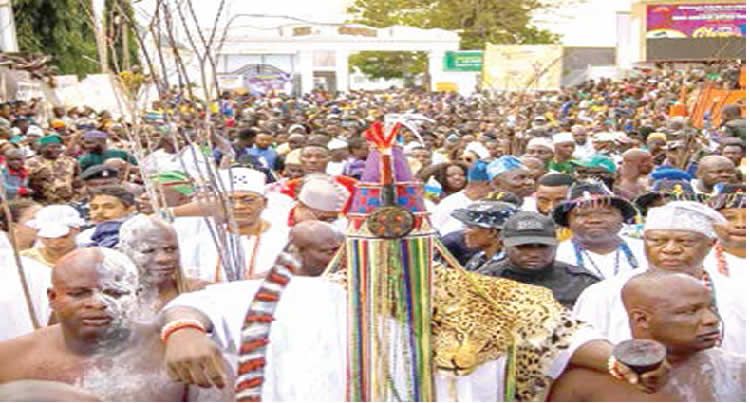
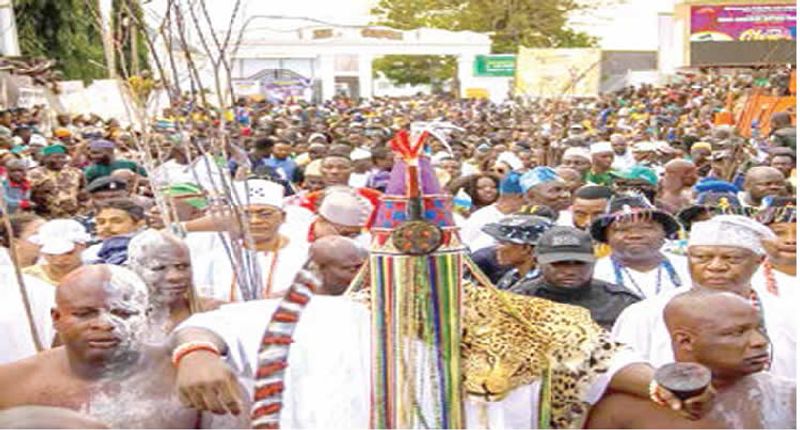
The hour has come again when the ancient drums of Ile-Ife summon the sons and daughters of Odùduwà worldwide to gather for the Olojo Festival, the day that the day becomes the day. From the cradle of civilisation, Ile-Ife, the spiritual headquarters of the Yoruba race, a sacred call goes out: Ile ya! Come home to celebrate heritage, reconnect with roots and renew the covenant of culture.This year’s Olojo Festival is not only a spiritual renewal but also a diplomatic and economic opportunity.

Global cultural organisations, such as UNESCO, the African Union Commission on Culture, the African Diaspora Institute, the Brazilian Institute of Afro-Heritage and many others are warmly invited to participate. Equally, the Federal Government under President Bola Tinubu must see it as a point of duty to invest, celebrate and globalise this sacred festival. Olojo is not just an event; it is an international tourism asset waiting to be harnessed, with Ile-Ife standing as both the Mecca and Jerusalem of the Odùduwà race. A well-packaged Olojo Festival can create jobs, boost Nigeria’s cultural GDP and draw revenues into the government’s coffers through tourism and heritage diplomacy.

When President Tinubu touched down in Brasília on Monday, August 25, 2025, the atmosphere was already primed for success. The visit produced five Memoranda of Understanding across trade, energy, aviation, science and finance. Air Peace was cleared to commence direct Lagos–São Paulo flights, while Brazilian aerospace giant Embraer firmed up commitments to expand its Nigerian footprint.Yet, these wins did not come from a cold start.

For nearly a decade, Arole Odùduwà, Olofin Adimula Ooni Adeyeye Enitan Ogunwusi, CFR, Ojaja II, the Ooni of Ife, had walked Brazil’s streets, temples and quilombos, carrying the Oduduwa story as living diplomacy. In 2018, he embarked on a 10-day historic tour of Brazil. In March 2023, he formally recognised Quingoma, Bahia, as Yoruba territory and helped inaugurate Isese Day in Brazil.

Those cultural touchpoints laid the foundation for statecraft. By the time Tinubu arrived, Brazil was already warmed to Nigeria’s story through a Yoruba lens.Indeed, in June 2025, Nigeria and Brazil signed a $1bn cooperation agreement covering mechanised agriculture, energy collaboration and food security, an institutional bridge that made the Brasília harvest of August 2025 possible.

Brazil is not the only frontier where Ooni’s cultural diplomacy prepared the ground for presidential strategy. In January 2025, President Kassym-Jomart Tokayev of Kazakhstan formally invited President Tinubu for a state visit. By June 2025, Ooni had already addressed the Astana International Forum, advocating Africa–Eurasia investment flows and briefed Tinubu in Lagos about Kazakhstan’s growing appetite for Nigerian partnerships. Weeks later, Kazakhstan’s foreign minister hosted Ooni to deepen cultural and economic cooperation.

Again, culture went ahead to make politics easier.The sequence is now visible: Cultural presence (2018–2025): Ooni’s recognition of Yoruba heritage in Brazil, convenings in Kazakhstan, and the globalising of festivals like Olojo.Policy architecture (June 2025): Nigeria–Brazil $1bn cooperation framework.Presidential harvest (August 2025): MoUs, direct flights, Petrobras talks and new investment flows.Each step compounds the next. Direct flights reduce barriers. Aerospace cooperation creates jobs.

Agricultural partnerships boost productivity. Energy resets build investor confidence. In short, identity is becoming GDP.As we gather in Ile-Ife for the Olojo Festival, the lessons are clear: culture is not a side show; it is the main stage. The Federal Government, cultural institutions, and the private sector must now treat Olojo Festival as a global brand. If Brazil could open economic doors on the back of Yoruba heritage, Ile-Ife can equally become a year-round pilgrimage and investment hub for the diaspora and the world.The bottom line is simple: when kings open doors with culture, presidents walk through with policy. Ooni’s long game has proven that the House of Odùduwà is not just a custodian of tradition but a living engine of Nigeria’s diplomacy and economy.

So as the Olojo Festival dawns, let the shout echo across continents:Ile ya! Come home!!• Seun Oketooto, Personal Assistant to the Director of Media & Public Affairs, Ooni’s Palace, writes from Ile Ife, Osun State
Tags

Opinion

Related Posts

Abia’s Q3 2025 Financial Report: Unanswered Questions, Conflicting Figures and Rising Transparency Concerns By Obinna Oriaku

Abia’s Q3 2025 Financial Report: Unanswered Questions, Conflicting Figures and Rising Transparency Concerns By Obinna Oriaku

The Abia Q3 2025 Financial Report has raised more questions than answers, exposing inconsistencies that deepen public mistrust in the state’s financial disclosures. Despite record-high FAAC disbursements nationwide and an increase in internally generated revenue, the state’s reported figures contradict earlier claims and fail to reflect development on the ground. Critical concerns include the exclusion of local government allocations from SEFTAS reports—funds controlled by the state but never publicly accounted for—alongside suspicious shifts in expenditure classifications. Previously controversial items such as the nearly ₦1 billion Security Vote and the ₦300 million Government House feeding bill have been obscured under vague headings like “Research and Development,” which has consumed over ₦34 billion since 2023 with no clear outcomes. Large sectoral allocations—including ₦14.4 billion for Land and Housing, ₦9.1 billion for Transport, and ₦13.2 billion for Education—remain unexplained, with no corresponding projects visible across the state. Meanwhile, Agriculture continues to receive negligible funding despite rising food inflation, and local government pension figures are being reported in ways that distort basic accounting principles. Taken together, these discrepancies paint a troubling picture of financial opacity. Abians are simply asking for transparency and honest accounting—nothing more. Until the government reconciles these conflicting figures and provides verifiable explanations, public confidence in its financial reporting will remain in serious doubt.

Africa’s AI moment: From consumption to digital sovereignty

Africa’s AI moment: From consumption to digital sovereignty

Africa stands at a pivotal moment in the global artificial intelligence revolution — a moment that will determine whether the continent remains a consumer of technology or emerges as a producer and rule-maker in the digital age. At the International Conference on Theory and Practice of Electronic Governance in Abuja, scholars from across the Global South warned that Africa risks repeating its historical role as a supplier of raw materials — this time in the form of data. Despite powering much of the world’s AI systems, the continent captures less than 2% of global AI investment. Through debates on data, economy, and politics, participants argued that digital sovereignty — control over data, infrastructure, and governance — is essential to breaking cycles of dependency. They called for strategic investment in digital infrastructure, skills, and policy, as well as equitable partnerships that promote technology transfer and local innovation. The emerging consensus was clear: AI is not merely a technical field but an arena of economic power and political agency. Africa must engage as an equal rule-maker, not a passive beneficiary. Like the Dangote refinery’s symbolism of industrial self-determination, building AI sovereignty will require vision, courage, and long-term investment. If pursued with intent, Africa can move from being the world’s digital quarry to a defining voice in shaping the global AI order.

Otti’s Rhetoric vs. Reality — Preaching Democracy While Practicing Selection.

Otti’s Rhetoric vs. Reality — Preaching Democracy While Practicing Selection.

Governor Alex Otti’s recent warning against election rigging — “Write your will before you write election results” — has made waves across Abia State. Yet, for many, his fiery rhetoric rings hollow. While he champions democracy publicly, Otti’s administration has been accused of bypassing internal party processes and handpicking local government officials through a splinter party seen as his personal vehicle. Critics argue that this selective practice of “elections” undermines the very democratic principles he claims to defend. As tensions rise ahead of the 2027 governorship race, Abians are left wondering: can Otti’s call for electoral integrity be trusted when his own record suggests otherwise?

Share this article